


Hello readers. As FPC pens this newsletter edition, Orbital’s Belfast (one of the finest ambient techno tunes) drifts in the background from the mega speaker unit built inside the FPC HQ. You will be glad to know Orbital’s greatest hits will soundtrack this edition’s musings.
Ever since FPC closed its second European M&A deal, we have been kicking around a big existential question: given the seismic technological (AI specifically) and economic (holding groups hogging spend) changes in the industry, what really constitutes a moat in ad tech?
We think there are four moats not just for commercial survival but also, more importantly, for a successful exit.
Four Horsemen Of The Ad Tech Apocalypse
Before we get into the four moats of ad tech M&A, it is worth naming the four horsemen that stalk every ad tech exec’s nightmare. FPC will dedicate a brief, snackable overview to each horseman and later do a more expansive newsletter on the topic.
The walled gardens: It’s fair to say the vampire squids of Silicon Valley are sucking a lot of value and upside out of the ad market. With scaled first-party data and the ultimate measurable loop, they’re an exhausting proposition to sell against.
Signal loss: Between the slow death of the cookie and Apple’s all-out attack on IDs, signal loss is a huge issue for independent ad tech. Relying on others’ goodwill is a road to nowhere.
Agency consolidation: The big holdcos have consolidated, and they’re hoovering up a lot of spend. That means fewer buyers and less access to budgets. Throw in the growing importance of principal media buying, and you have a grim commercial picture for ad tech.
AI: Anyone can build anything now thanks to the magic of AI. FPC has seen agency groups reverse-engineer ad tech in a day. When the price of software development goes to zero, much of feature-focused ad tech starts to look like the Emperor’s new clothes.
So now that we’ve got that apocalyptic biblical reference out of the way, let’s focus on what will thrive and survive going forward.
The Four Moats That Might Just Save Ad Tech
Below is a handy graphic featuring the four moats of ad tech M&A - namely, Network Effect, Infrastructure, Proprietary Data & Embedded Workflow. FPC has done two European ad tech deals in the space of twelve months, and that process, as well as extended internal debate, has landed us on this new thesis.
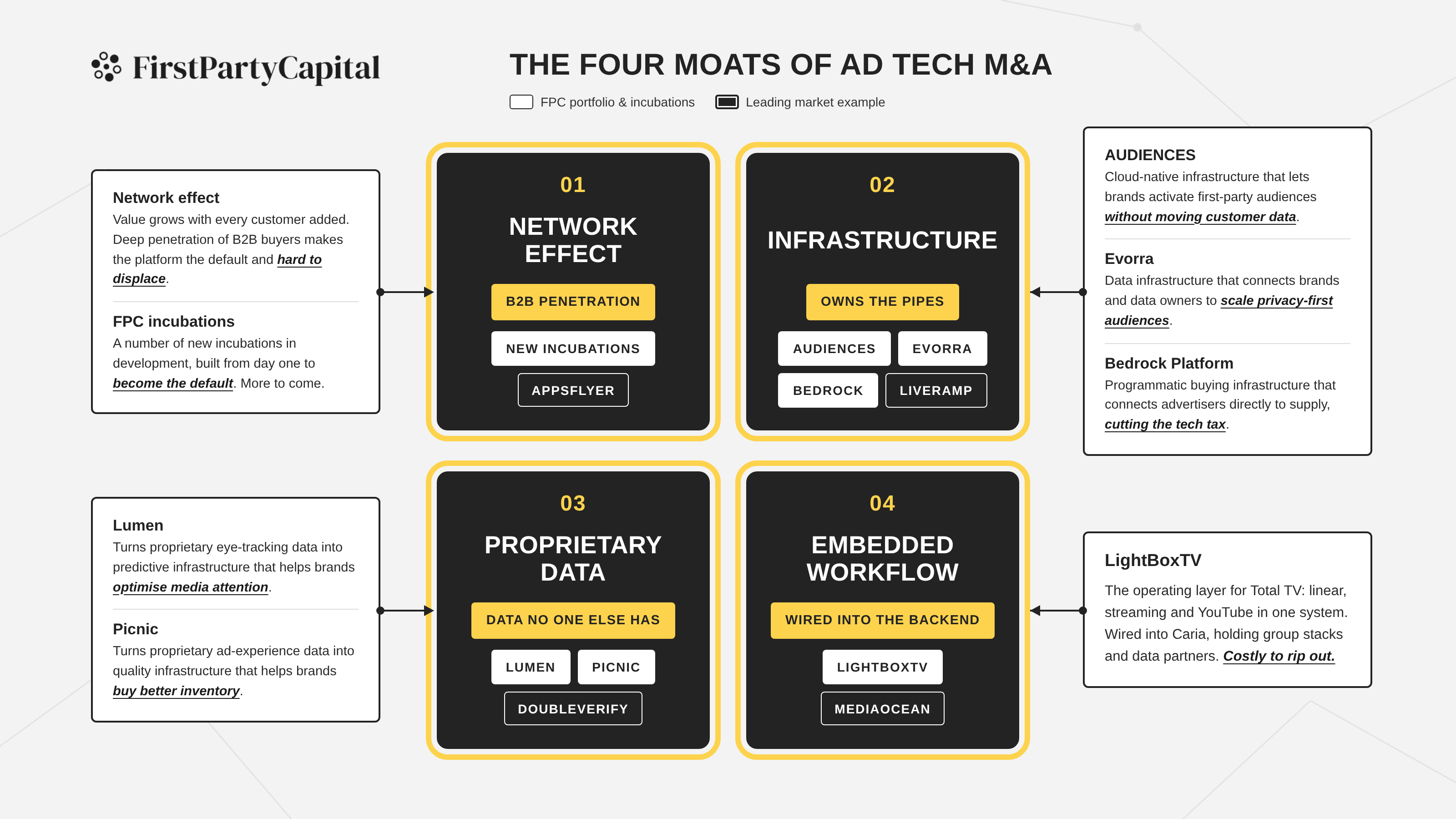
Let’s dig into those four quadrants that will get you sold and save you from inevitable commoditisation:
Network Effect: How integral is your product to the market? How deep is your penetration in a specific vertical? Salesforce got shish-kebabbed during the recent SaaSpocalypse hokum, until the attic-dwelling vibe coders realised how integral it is to its customers. It is baked into every facet of their operations, surrounded by an ecosystem of apps, partners and consultants that compounds with every new customer. Network effects matter more than ever as software becomes increasingly commoditised and copyable. FPC is working on several new incubations built around this moat. More on those soon.
Infrastructure: Any company in ad tech could argue it is infrastructure. Very few can back that up. True ad tech infrastructure is an enabling layer: the pipes your operation runs on. Evorra and AUDIENCES are the back-end data layers that brands, agencies and publishers need for data-driven media execution. Likewise, Bedrock Platform is the foundation for programmatic activation at scale. It doesn’t wedge itself into the middle of your stack to charge unnecessary obfuscated fees. In short, these companies are necessary building blocks, not ad tech tax bloat.
Proprietary data: This is probably the most compelling quadrant. With traditional IDs in terminal decline and Apple waging an all-out war on ID-based ad tech, signal decay is very real. Non-ID-based proprietary signals will become a prerequisite for this industry. They won’t just power targeting and measurement; they’ll also train agents and fuel custom algos. That makes companies like Lumen, with its proprietary eye-tracking data, and Picnic, with its ad-experience data, more important than ever for agencies, brands and ad tech at large. Stay tuned for a big announcement on the proprietary data front next week, as we launch a new incubation in this signal space. We are all in on this.
Embedded workflow: As you know, FPC loves boring, boring companies, and there’s nothing better than the ones that do the wiring in ad tech. One of our favourites is Mediaocean. Its Prisma platform is the unglamorous back-office plumbing that runs agency billing, and nobody has ever managed to rip it out. That’s a proper moat. It’s also why we love LightBoxTV. When Mark Giblin and Dean Cussell conceived a solution for managing and activating convoluted TV spend across linear, CTV, YouTube and “emerging TV”, we were the first to invest, and we proudly remain its biggest outside shareholder. LightBoxTV now powers the back end for a number of big agencies and manages more than £600 million of UK TV spend a year, and growing. Wired into Caria, holding group stacks and data partners, it has become essential for its clients. Let’s call it the Mediaocean of TV: a respectful hat tip to the granddaddy of ad tech workflow.
As an investor in and seller of European ad tech businesses, FPC has to be very discerning about which companies we back and sell. With a category 5 AI hurricane having levelled ad tech valuations, founders need to think very differently. We believe our new four-moat thesis can lead the way through the carnage.
Build around these moats, and you’ll do well. Build with legacy ad tech thinking, and you’ll inevitably end up in the zadtech (zombie ad tech) category. On that note, FPC will put on Chime and ruminate some more on the future of ad tech investment (and exits!). Until next time.