


Hello readers. Welcome to our regular biased view of the trillion-dollar ad business. As you know, we are all about ad tech and martech investment at FPC. We invest. We build. We scale. The goal, of course, is to achieve an outcome and return money to our LPs. We operate in a BIG market. Ad tech powers this trillion-dollar business. That’s correct. But don’t the walled gardens control 80% of that? Correct. And ad tech builds for that? Uhm, sort of.
For all its innovation, ad tech has a huge blind spot - namely, the walled gardens where consumers spend the majority of their free time. There are companies helping agencies and marketers navigate these standalone ecosystems. We are calling them PBTs (Platform-Based Technologies) - essentially native ad tech for YouTube or a TikTok built on the platform’s O&O APIs.
FPC believes it is a massively underserved part of the ad tech market. In this edition, we are talking about the humble PBT - what they are and how they can make you money.
The Legacy Of Open Web Thinking
There was an interesting exchange on a recent episode of Marketecture between Jim Payne and hosts Ari Paparo and Eric Franchi. Jim, a prolific builder of mobile-based ad tech and current CEO at CloudX, joked that Ari and Eric were “open web ad tech guys” - which, to be fair to both, is not really the case.
The awkward banter did provoke a bigger thought in FPC’s scrappy brain: does the industry suffer from some sort of myopia when it comes to building tech? Are we a web-first sector? Most of the standards we have are grounded in the open web. The programmatic ecosystem, for the most part, has been built to monetise open web inventory - and that technology is now being graphed onto other channels with varying degrees of success.
Now that the open web is declining (referral traffic down, changed consumer behaviour, shifting budgets) amid the rise of chatbots and Q&A search engines, a rethink is happening. App, OOH, audio, and CTV will be major focuses for ad tech. But why not walled gardens?
There seems to be an aversion to building for walled gardens; FPC can see why. Nobody wants their destiny controlled by Google (certainly not) or TikTok. Trading RTB for native API integrations requires significant investment and a major mindset shift. Data and measurement are also huge issues. It is one giant, convoluted “black box” that you could argue serves only its master.
Regardless, this walled-garden ad-tech market (PBTs) is an untapped opportunity. Like it or not, walled gardens keep growing in terms of user engagement and ad spend.
For marketers and agencies, walled gardens continue to be difficult to navigate across targeting, measurement, brand safety and inventory curation. Buyers need to do all of this at scale. And they need 3rd parties to fill that capability gap.
The Walled Garden: More Ecosystem Than Supply Partner
The raging hot takes around YouTube’s TV credentials pollute the LinkedIn news feed. Industry leaders and influencers get themselves into such a lather about “the quality” of YouTube inventory. It is such a reductive debate. What’s TV anyway these days?
YouTube is not just a supply of online video/CTV inventory; it is a living, breathing ad ecosystem. Ad spend is expected to reach $45 billion this year, nearly on par with OOH.
Agencies spend big on YouTube. But it remains a messy process, trying to buy and optimise for quality on a platform dominated by garbage content and, increasingly, AI-generated slop. Google wants the money but, in many respects, doesn’t care how it pockets that media spend. Not helpful to buyers.
It is not just the buyside that needs help. Increasingly, top-tier publishers and broadcasters are using YT to distribute their premium content. The problem is that they are not getting premium prices. The YT algo on the platform invariably commoditises premium content, valuing it similarly to UGC.
PBTs like FPC portco, ContxtMedia, are helping pubs increase YT ad yield. Its video metadata solution ingests content at scale to provide better signals, custom inclusion lists, and brand-safe inventory. This is a boring (we love boring) backend company that doesn’t take a position in the media - just supercharges the buying signal so partners can make more money. Buyers want quality and performance; ContxtMedia provides both.
A YouTube PBT Ecosystem Map
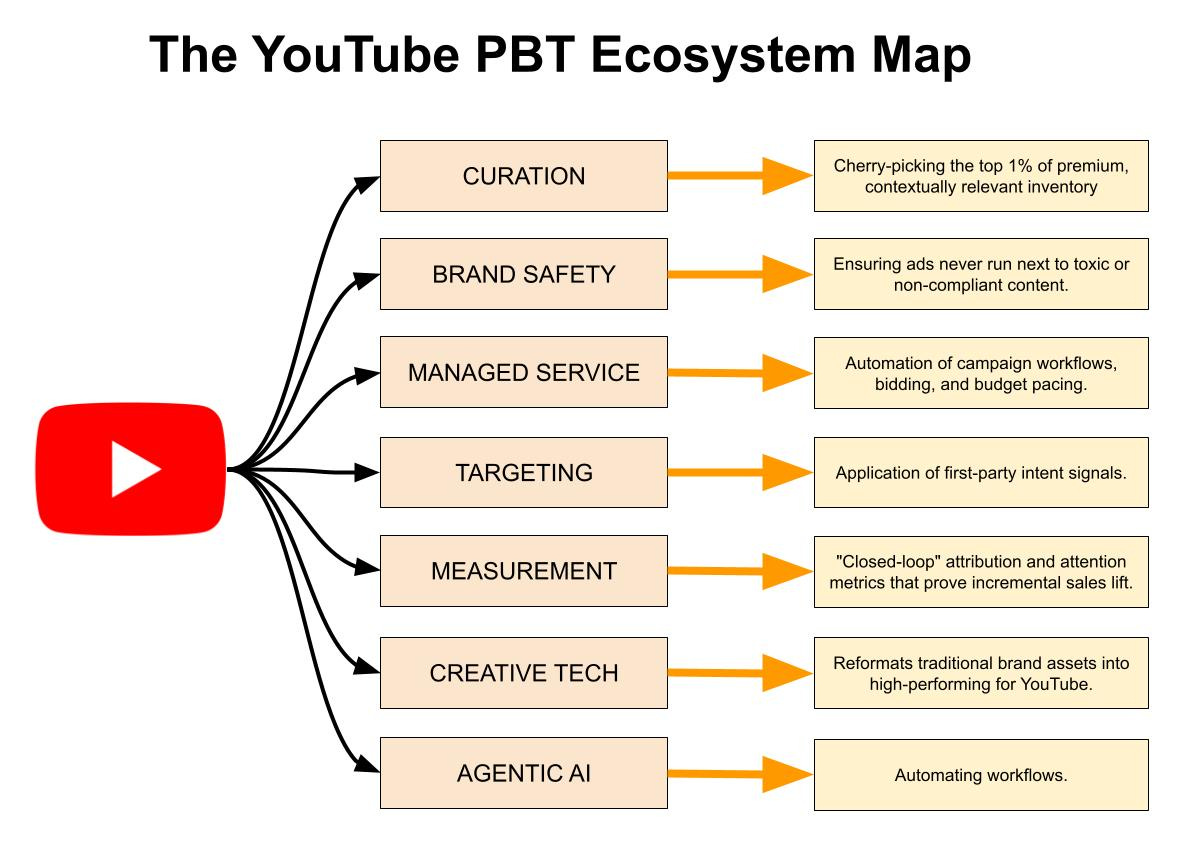
There are 3rd-party ad tech vendors making decent money and garnering big valuations by focusing heavily on YouTube - thinking about the likes of Channel Factory and Zefr. Within the YT ecosystem, there are a bunch of specific categories PBTs are building solutions for.
To illustrate the opportunity, FPC has put together a crude visual overview of the YouTube PBT category landscape:
The Investment Rationale
The walled garden penetration is more pronounced outside the US. The further east you go, the more dependent marketers and agencies become on YT/Google/Amazon/Meta/TikTok/Snap.
There are two ways to invest for this: 1) invest in solutions building for omnichannel; and 2) fund platform native ad tech.
You’ll be glad to hear we are doing both. On the first one, we have already made significant bets (cc Lumen, the omnichannel attention company) and have a bunch of incubations that will be backing (startups like MedMerge, a non-US pharma/health targeting solution for walled gardens).
On the native ad tech builds, we are already into the likes of ContxtMedia, and are lining up investment in TikTok and YT solutions.
Having a nuanced view of ad tech is requisite if you want to thrive and survive. FPC has adopted that view from day 1. Remember again, this is not the US. You do not have the luxury of a single deep and liquid ad market that can support an open web investment thesis.
The PBT is a thriving (and very investable) ad tech category - and we are making sure our LPs have decent exposure to this outrageously overlooked segment of the market.
And that’s it, readers. Another TLA (oh, yeah) is born. Have a great ad tech day.